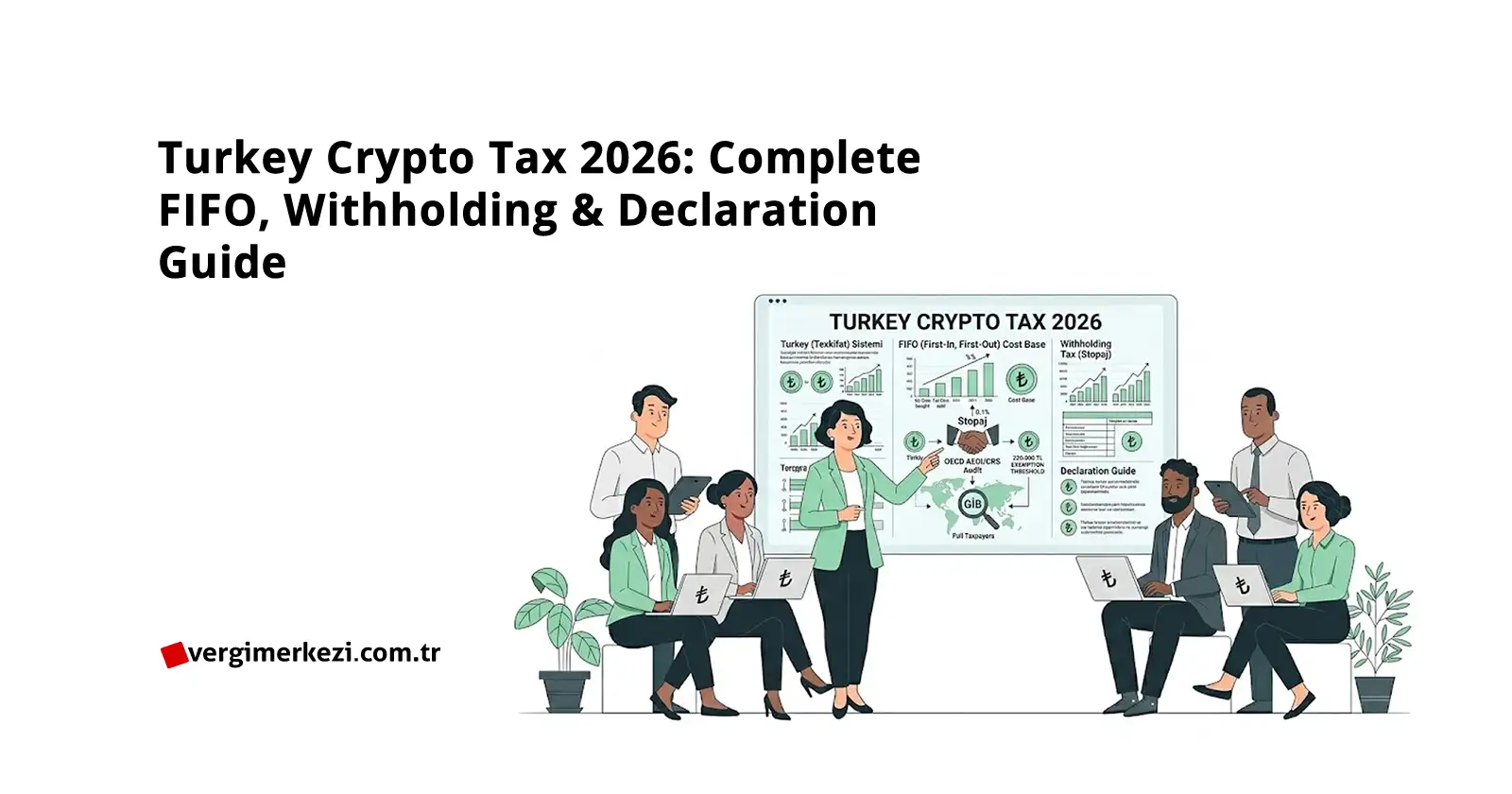
What are the legal tax obligations for foreign investors, expats, and digital nomads holding or trading crypto assets in Turkey in 2026 — and what steps must be taken to ensure full legal compliance before the March filing deadline?
As of 2026, Turkey is in the final stages of enacting a landmark crypto-specific tax framework, with a comprehensive legislative proposal submitted to the Grand National Assembly (TBMM) in March 2026. Even prior to this legislation’s formal passage, crypto asset gains have been taxable under Income Tax Law No. 193. For individuals qualifying as full taxpayers (tam mükellef) in Turkey, profits realized from crypto trading, mining, staking, or airdrops during 2025 must be carefully calculated and declared during the March 1–31, 2026 annual tax return window. The emerging legal architecture — built on FIFO cost basis rules, a 10% withholding tax on SPK-licensed platforms, and a 0.03% transaction levy — demands a structured compliance approach. This guide covers everything expats, digital nomads, and foreign investors need to know.
2026 Turkey Crypto Tax Summary
Tax Feature
Description / 2026 Value
Asset Classification (Legislative Proposal)
Intangible Asset under Capital Markets Law No. 6362; Capital Gain (Değer Artış Kazancı) under Income Tax Law No. 193
SPK-Licensed Platform — Tax Mechanism
10% withholding applied by the platform on net quarterly profits (final tax; no annual return required)
Crypto Asset Transaction Tax
3/10,000 (0.03%) on sale or transfer value (tax is levied on the platform, not the investor)
Foreign / Unlicensed Platform Gains
Full taxpayer must file Annual Income Tax Return each March
Mining / Staking Income
“Incidental Earnings” (Arızi Kazanç) or “Self-Employment Income” depending on scale and regularity
Mandatory Cost Method
FIFO (First-In, First-Out)
Loss Offset
Within the same calendar year and same asset class only; no carry-forward to the next year
VAT Treatment
Crypto asset transactions are VAT-exempt
Non-Resident (Dar Mükellef)
Generally not liable for Turkish tax on crypto (unless income is sourced in Turkey as salary/wages)
The 2026 Legal Framework: Tam vs. Dar Mükellef (Full vs. Limited Taxpayer)
The foundation of crypto taxation in Turkey rests entirely on your residency status. Under Turkish Income Tax Law, two categories of taxpayers exist:
Full Taxpayer (Tam Mükellef): An individual who resides in Turkey for more than six consecutive months in a calendar year, or whose legal domicile is established in Turkey, is classified as a full taxpayer. Full taxpayers are liable for income tax on their worldwide income — this means crypto profits realized on foreign platforms such as Binance Global, Coinbase, Kraken, or OKX are fully taxable in Turkey, regardless of where the exchange is registered.
Limited Taxpayer (Dar Mükellef): Foreign nationals and non-residents are taxed only on income generated within Turkish territory. Passive crypto gains made on foreign platforms with no Turkish nexus generally fall outside the Turkish tax base for limited taxpayers. However, if a limited taxpayer works remotely for a Turkish entity or receives crypto-denominated wages sourced from Turkey, those earnings are treated as Turkey-sourced salary income and are subject to withholding.
💡 Critical Information: The six-month residency threshold is calculated per calendar year. Frequent travelers or digital nomads who spend time in Turkey should track their days carefully. A single calendar year stay exceeding 183 days triggers full taxpayer status — and with it, the obligation to declare global crypto profits. Additionally, if you receive your salary in cryptocurrency through an Employer of Record (EOR) arrangement in Turkey, this is treated as standard wage income subject to progressive income tax rates — not as a capital gain.
Withholding Tax (Stopaj) vs. Annual Declaration
A persistent source of confusion for foreign investors is the distinction between the crypto asset transaction tax, the new platform-level withholding mechanism, and the annual income tax declaration. These three mechanisms differ in timing, legal basis, and practical impact.
Crypto Asset Transaction Tax — 0.03% (3/10,000)
The legislative proposal introduces a dedicated Crypto Asset Transaction Tax under the Expenditure Taxes Law. Under this mechanism:
A levy of 3/10,000 (0.03%) is applied to every sale or transfer of crypto assets executed through or intermediated by a crypto asset service provider (exchange).
The legal taxpayer is the platform itself, not the individual investor — but in practice, this cost is absorbed into the transaction fee structure.
The President of the Republic holds the authority to reduce this rate to zero or increase it up to five times (0.15%) depending on asset class or transaction type.
This tax applies irrespective of profitability: whether a trade results in a gain or a loss, the transaction tax is triggered at the moment of execution.
No deductions or offsets are permitted against the transaction tax base.
10% Income Withholding on SPK-Licensed Platforms
The most consequential change in the legislative proposal is the introduction of a 10% income withholding tax on profits realized through Capital Markets Board (SPK)-licensed crypto platforms. Key mechanics:
The platform calculates net profits on a quarterly basis using the FIFO method and withholds 10% of the net gain.
This withholding is the final tax for these transactions — investors trading exclusively on SPK-licensed Turkish platforms are not required to file an annual income tax return for those gains.
Deductible costs include acquisition price (per FIFO), transaction commissions, and transaction taxes paid.
Losses incurred in one quarterly period within the same asset class can be carried forward and netted against gains in the next period, within the same calendar year only.
When transferring crypto assets between platforms, the investor must notify the receiving platform of the original acquisition cost and date to preserve the FIFO chain. Failure to do so creates mismatch risks and potential audit exposure.
March Annual Declaration — Foreign Exchanges & Unlicensed Platforms
Any crypto gains realized outside of SPK-licensed platforms — including all foreign exchanges and peer-to-peer transactions — must be declared by full taxpayers via the Annual Income Tax Return filed with the Turkish Revenue Administration (GİB) between March 1 and March 31, 2026.
Key rules:
All gains must be converted to Turkish Lira using the Central Bank of Turkey (TCMB) exchange rate on the date each transaction was executed.
Foreign taxes already paid on the same income may be credited against Turkish tax liability under Article 123 of the Income Tax Law, up to the amount of Turkish tax attributable to that income.
Gains from foreign platforms are aggregated with other relevant income sources for progressive rate application.
The filing is made through GİB’s Hazır Beyan (pre-filled return) system or via a certified public accountant (CPA).
Cost Basis Calculation: The FIFO Method
The legislative proposal codifies FIFO (First-In, First-Out) as the mandatory cost basis method for all crypto asset gains calculations in Turkey. Under FIFO, when you sell a portion of a crypto holding accumulated over multiple purchases, the cost of the earliest-purchased coins is consumed first.
Additional rules governing FIFO application:
Loss Harvesting: Within the same calendar year (2025), crypto trading losses from the same asset class can offset crypto trading gains. This applies to both platform-withheld and self-declared income.
No Carry-Forward: Net capital losses from crypto cannot be carried forward to the next tax year (2026). Any unabsorbed loss at December 31 is permanently forfeited.
Cold Wallet to Exchange Transfers: Moving crypto from a cold wallet to an exchange is not a taxable event in itself. However, the investor must maintain records of the original acquisition cost and date, as these form the FIFO basis when the asset is eventually sold.
Cross-Platform Transfers: When moving assets between exchanges, the original purchase cost must be communicated to the new platform. Without this disclosure, the new platform may calculate gains using the market value at the time of transfer as the cost basis — resulting in over-taxation or audit discrepancies.
Practical FIFO Example
The table below illustrates how FIFO applies to a partial Bitcoin sale:
Date
Transaction
Units
Unit Price (TRY)
Total Cost (TRY)
January 10, 2025
Purchase
2 BTC
2,500,000
5,000,000
February 15, 2025
Purchase
1 BTC
3,200,000
3,200,000
March 20, 2025
Sale
2 BTC
4,000,000
8,000,000
FIFO Cost Realization: The 2 BTC sold are matched against the January purchase lot (2 × 2,500,000 = 5,000,000 TRY). The February lot remains untouched.
Component
Amount (TRY)
Sale Proceeds
8,000,000
FIFO Acquisition Cost
5,000,000
Net Taxable Gain
3,000,000
10% Withholding (SPK-licensed platform)
300,000 (deducted by platform)
Transaction Tax 3/10,000
2,400 (on sale value of 8,000,000)
Remaining Feb Lot Cost Basis
3,200,000 (carried forward for next sale)
2026 Progressive Income Tax Brackets
For gains declared via the Annual Income Tax Return (foreign exchanges and unlicensed platforms), Turkey applies the progressive rate schedule under Article 103 of the Income Tax Law. Crypto gains are classified as non-wage income; the following brackets — updated by VUK General Communiqué No. 588 (Official Gazette, December 31, 2025, 5th Reiteration) using the 49% revaluation rate — apply:
Annual Net Taxable Income (TRY)
Marginal Rate
Cumulative Tax Calculation
Up to 190,000
15%
—
190,001 – 400,000
20%
28,500 + 20% on excess above 190,000
400,001 – 1,000,000
27%
70,500 + 27% on excess above 400,000
1,000,001 – 5,300,000
35%
232,500 + 35% on excess above 1,000,000
Above 5,300,000
40%
1,737,500 + 40% on excess above 5,300,000
Important Note: The third bracket threshold for salary income is 1,500,000 TRY. Since crypto gains are treated as non-wage income (capital gains / incidental earnings), the lower threshold of 1,000,000 TRY applies. High-volume traders should plan accordingly — significant gains push into the 35% and 40% brackets rapidly.
DeFi, Staking, Airdrops, and NFTs
Many competing guides ignore the nuances of decentralized finance. In Turkey, passive income from blockchain-native activities is treated differently from trading gains:
Staking and Yield Farming: Rewards received from staking or liquidity provision protocols are classified as Incidental Earnings (Arızi Kazanç) at the moment of receipt. The taxable amount is the fair market value of the tokens in Turkish Lira at the exact time they are credited to your wallet. When those tokens are subsequently sold, the difference between the sale price and the originally recorded receipt value is then treated as a Capital Gain.
Airdrops: Tokens received via airdrop are recognized as Incidental Earnings at receipt (fair market value at credit date). Subsequent sale generates a Capital Gain calculated from that same cost basis.
Mining Income: Classified based on scale and regularity. Occasional, small-scale mining may qualify as Incidental Earnings (lower compliance burden). Systematic, high-volume mining operations are more likely to be characterized as Self-Employment Income (Serbest Meslek Kazancı), which carries separate quarterly filing obligations and social security implications.
NFTs (Non-Fungible Tokens): NFT sale proceeds are generally treated as commercial income in Turkey. Whether the exemption under Article 18 of the Income Tax Law (applicable to artists and authors) covers NFT sales representing original digital art remains a contested point; a ruling from GİB has not yet been issued as of early 2026.
Inheritance and Gift: Crypto assets transferred via inheritance or gift are subject to Inheritance and Gift Tax (Veraset ve İntikal Vergisi), calculated on the Turkish Lira fair market value at the date of transfer.
Cold Wallets and Crypto-to-Crypto Conversions
Cold Wallets (Ledger, Trezor, etc.): Holding crypto assets in a self-custodied hardware wallet creates no tax liability in itself. The taxable event arises only upon disposal — meaning a sale for fiat currency, conversion to another crypto asset, or use in a transaction. Unrealized gains on assets held in cold storage are not taxed.
Crypto-to-Crypto Conversions: Under the OECD CARF standards now being applied in Turkey, swapping one crypto asset for another (e.g., BTC → ETH) constitutes a taxable disposal event. The gain or loss is calculated as the difference between the fair market value of the received asset (in TRY, at conversion date) and the FIFO cost basis of the disposed asset. Investors who execute frequent crypto-to-crypto trades on decentralized exchanges must track each swap individually — these transactions do not simply “reset” the cost basis tax-free.
Global Audits: AEOI / CARF Risks in 2026
The highest compliance risk for expats and digital nomads residing in Turkey is the intersection of two international reporting frameworks: the Automatic Exchange of Information (AEOI) governed by the OECD’s Common Reporting Standard (CRS), and the newer Crypto-Asset Reporting Framework (CARF), which reaches full operational capacity in 2026.
Under these frameworks:
Turkey actively exchanges financial data with over 100 jurisdictions, including the EU, UK, Switzerland, and major offshore centers.
CARF mandates that compliant global exchanges — including Binance, Coinbase, Kraken, and OKX — report Turkish tax residents’ wallet balances, transaction histories, and annual realized gains directly to the Turkish Ministry of Treasury and Finance (GİB), based on the KYC (Know Your Customer) data collected at account opening.
This data exchange occurs automatically and periodically, without requiring GİB to issue a specific information request.
A second risk vector operates domestically: large fund transfers from an unlicensed foreign exchange to a Turkish bank account trigger suspicious transaction reporting obligations (MASAK — Financial Crimes Investigation Board). A MASAK report can initiate a retroactive five-year audit of the taxpayer’s full tax history.
The practical implication is clear: the assumption that gains held on foreign exchanges are invisible to Turkish authorities is no longer defensible. GİB holds the legal authority to initiate retroactive audits covering five calendar years, and detected undisclosed offshore crypto income results in layered penalties as described below.
Penalties for Non-Compliance
Failure to declare crypto income — or underreporting — simultaneously triggers multiple penalty mechanisms under the Tax Procedure Law (VUK):
Tax Loss Penalty (Vergi Ziyaı Cezası — VUK Articles 341 & 344): Any shortfall in tax paid due to the taxpayer’s failure to meet obligations constitutes a “tax loss.” The standard penalty equals 1× the amount of tax lost. Where the loss is caused by tax evasion methods listed under VUK Article 359 (falsified documents, concealment of books, etc.), the penalty rises to 3×. Following the August 2, 2024 legislative amendment, undeclared activities causing tax loss attract a 1.5× multiplier.
Default Interest (VUK Article 112): Daily default interest accrues on the unpaid principal tax from the original due date to the actual payment date. Given Turkey’s inflation environment, multi-year accrual can make this component substantial.
Special Irregularity Penalty (VUK Mükerrer Article 355): For failure to submit electronic declarations and notifications, a fixed penalty of 35,000 TRY (2026 rate, first-tier taxpayers) applies per violation.
Criminal Prosecution (VUK Article 359): In cases involving intentional large-scale tax evasion or systematic concealment, the matter is referred to the criminal courts. Conviction under Article 359 can result in imprisonment in addition to financial penalties.
Penalty Reduction (VUK Article 376): If the taxpayer accepts the tax loss penalty within 30 days of the assessment notice and commits to paying in full, a 50% reduction applies to the penalty for a first offense. Irregularity penalties attract a one-third reduction under the same conditions.
Frequently Asked Questions
Do expats in Turkey have to pay taxes on crypto?
Yes — if you reside in Turkey for more than six consecutive months in any calendar year, you are classified as a full taxpayer (tam mükellef) and must declare global crypto profits exceeding applicable thresholds using the FIFO method. The March 1–31 annual filing window is the critical deadline for 2025 gains.
Can I deduct my crypto trading losses?
Yes, within limits. Crypto trading losses realized in the same calendar year (2025) can be offset against crypto gains from the same asset class. However, any net loss position at December 31 cannot be carried forward to the following tax year — it is permanently lost for tax purposes.
Does the Turkish government know about my foreign Binance account?
Yes, with a high degree of certainty. Through the OECD AEOI/CRS framework and the newly operational CARF standard, compliant global exchanges share KYC-linked account data — including balances and realized gains — with the Turkish Revenue Administration on a regular, automated basis. This data is matched against declared tax returns. Non-declaration is detectable and subject to retroactive five-year audits.
Is converting Bitcoin to Ethereum a taxable event in Turkey?
Yes. Under CARF-aligned interpretation, swapping one crypto asset for another constitutes a disposal and triggers a Capital Gain calculation based on the fair market value difference at conversion, using FIFO cost basis for the disposed asset.
What happens if I move my crypto from a cold wallet to a Turkish exchange?
The transfer itself is not a taxable event. However, you must be prepared to document the original acquisition date and cost of the transferred assets, as the exchange will need this data to apply FIFO correctly when you eventually sell.
Are there any crypto income tax exemptions for residents?
Under the current framework, there is no categorical exemption for crypto gains. General income tax rules — including the standard filing thresholds — apply. If total net capital gains from all qualifying assets fall below the applicable exemption threshold for non-wage income, a return may not be required. Consult a certified public accountant (CPA) to assess your individual position.
Professional Tax Support
Crypto taxation in Turkey involves complex FIFO modeling, progressive tax brackets, international tax credits, and AEOI audit risk management. Miscalculations or omitted declarations can result in severe financial penalties. Vergi Merkezi | Mali Müşavirlik provides enterprise-grade compliance, tax calculation, and declaration services for expats and digital nomads.
Ready to establish or grow your business in Turkey? Contact Vergi Merkezi | Mali Müşavirlik today for a consultation with our expert accountants.
📍 Service Areas: Istanbul, Ankara, Izmir, and all of Turkey.
⚠️ Legal Disclaimer: This content reflects the legislative landscape and GİB guidance as of March 2026. Crypto tax regulations remain subject to rapid legislative change. Always consult a qualified professional at Vergi Merkezi | Mali Müşavirlik for advice tailored to your individual circumstances.
📚 Sources and References
Turkish Official Gazette — Income Tax Law No. 193 (Articles 3, 4, 65, 75, 80, Mükerrer 80, 82, 89, 103, 123), Tax Procedure Law (VUK) (Articles 112, 341, 344, 355, 359, 376), Capital Markets Law No. 6362. 2025/2026 Legislative Updates.
VUK General Communiqué No. 588 — Revaluation Rate and 2026 Income Tax Bracket Thresholds. Official Gazette: December 31, 2025 (5th Reiteration).
TBMM Legislative Proposal (March 2026) — “Draft Law on Amendments to Certain Laws”: Crypto Asset Transaction Tax (Expenditure Taxes Law, Article 35), 10% Platform Withholding Mechanism, FIFO Mandatory Method, and SPK-Licensed Platform Tax Architecture.
Capital Markets Board of Turkey (SPK) — Communiqué on the Establishment and Operating Principles of Crypto Asset Service Providers; Communiqué on Working Procedures and Principles.
Revenue Administration of Turkey (GİB) — Guide to the Taxation of Crypto Assets, 2025.
OECD — Common Reporting Standard (CRS); Automatic Exchange of Information (AEOI) Implementation Handbook; Crypto-Asset Reporting Framework (CARF); G20 Data-Sharing Standards.