


Operating in the Turkish market as a foreign entity requires navigating a complex regulatory landscape centered on two critical roles: the Responsible Person (RP) for regulatory compliance and the Importer of Record (IOR) for customs and fiscal accountability. The year 2026 marks a transformative period for Turkish trade, characterized by the total abolition of the €30 customs duty exemption for e-commerce and the implementation of stricter TAREKS (Risk-Based Control System in Foreign Trade) protocols. Presidential Decision No. 10813, effective as of February 6, 2026, mandates that all B2C shipments, regardless of value, must now undergo formal customs clearance, making the IOR and RP functions indispensable for any foreign brand seeking to maintain a presence in the country.
RP and IOR 2026 Summary Comparison Table
| Feature | Responsible Person (RP) | Importer of Record (IOR) |
|---|---|---|
| Primary Scope | Product Safety & Regulatory Compliance | Customs, Tax & Legal Entry |
| Regulatory Body | Ministry of Health (TİTCK) | Ministry of Trade (Customs) |
| Mandatory For | Cosmetics, Medical Devices, Biocidals | All Commercial Imports |
| Residency Requirement | Must be established in Turkey | Must be a Turkish legal entity |
Defining the Responsible Person (RP) in Turkey
The Responsible Person is the locally established entity that assumes full legal accountability for the safety and compliance of specific product categories—most notably cosmetics and medical devices—placed on the Turkish market. Under the Turkish Cosmetics Regulation, which aligns with EU Regulation 1223/2009, a product cannot be sold unless an RP is appointed. The RP acts as the primary interface between the manufacturer and the Turkish Medicines and Medical Devices Agency (TİTCK).
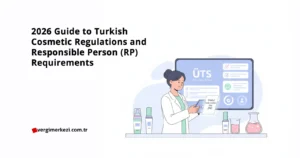
Key responsibilities of the RP include maintaining the Product Information File (PIF), ensuring that labels are in Turkish, and managing notifications via the Product Tracking System (ÜTS). For 2026, the RP’s role has expanded to include mandatory digital product passport integration and real-time reporting of serious adverse effects within a strict 15-day window. Appointing a qualified RP is not merely a formality; it is a prerequisite for passing TAREKS inspections during the importation phase.
The Role of the Importer of Record (IOR)
While the RP handles what is inside the box (safety and technical specs), the Importer of Record is responsible for getting the box into the country. The IOR is the legal owner or authorized representative who ensures that goods are documented correctly, duties are paid, and the shipment complies with the Turkish Customs Law. Since non-resident companies cannot hold a Turkish tax ID or import license directly, they must partner with a local entity to serve as the IOR.
As of February 2026, the IOR’s responsibility has intensified due to the removal of simplified customs regimes for low-value goods. Previously, packages under €30 could enter with minimal paperwork; now, every single item requires a standard customs declaration, making the IOR’s role in managing HS code (GTİP) classification and TAREKS applications crucial to avoiding shipment seizures or heavy fines.
2026 E-Commerce Revolution: Abolition of the €30 Exemption
On January 7, 2026, Presidential Decision No. 10813 was published in the Official Gazette, fundamentally altering cross-border e-commerce in Turkey. This decree, which became fully effective on February 6, 2026, ended the era of duty-free personal shopping for items valued under €30. This move was designed to protect domestic manufacturers and increase product safety oversight at the border.
Under the new regime, all e-commerce shipments are subject to:
- Standard Customs Declaration: No more simplified entry; full documentation is required.
- Increased Duties: EU-origin products face a 30% tax, while products from non-EU countries (such as China or the USA) are taxed at 60%.
- Luxury Tax: Certain items may incur an additional 20% Special Consumption Tax (ÖTV).
For foreign sellers, this means that “Direct-to-Consumer” shipping now requires a sophisticated IOR solution to manage the individual tax payments and gümrük (customs) procedures for every customer package.
Critical TAREKS and ÜTS Updates for 2026
The TAREKS system, which controls the quality and safety of imported goods, has seen significant updates for the 2026 fiscal year. Importers can no longer rely on “out-of-scope” reference numbers that were previously reused across years. Every shipment must now be evaluated case-by-case within the digital portal. For medical devices and cosmetics, this is tied directly to the RP’s registration in the ÜTS. If the RP has not updated the product’s technical file in accordance with 2026 standards, TAREKS will automatically block the import, leading to warehouse (ardiye) costs and potential re-export requirements.
📌 Implementation Note: Ensure that your RP has uploaded the 2026 updated GMP (Good Manufacturing Practice) certificates to the ÜTS before the goods reach the Turkish border to prevent TAREKS delays.
Steps to Establish Compliance for Foreign Companies
- Appoint a Responsible Person (RP): Must be a Turkish resident or a locally established entity with technical expertise (Pharmacist, Chemist, or specialized firm).
- Register on ÜTS: Perform electronic notification of all products and ingredients to the TİTCK portal.
- Select an IOR Partner: Ensure your local partner has the necessary import licenses and a clean record with the Ministry of Trade to avoid “red line” inspections.
- HS Code Audit: Conduct a thorough review of GTİP (HS Codes) for your entire catalog to ensure accurate tax calculation under the 2026 duty rates.
- Labeling Compliance: All labels must be in Turkish and include the RP’s name and address before shipment.
Risk Analysis: The Cost of Non-Compliance
The Turkish Ministry of Trade has signaled a “zero tolerance” policy for 2026 regarding e-commerce and technical compliance. Failure to appoint a proper RP or using an unauthorized IOR can lead to:
- Seizure of Goods: Shipments without a valid ÜTS registration are deemed “unsafe” and may be destroyed.
- Administrative Fines: Fines can reach up to three times the value of the goods for incorrect tax declarations or missing TAREKS approvals.
- Blacklisting: Frequent compliance failures can result in the local entity being blacklisted, preventing all future imports.
Frequently Asked Questions
Can a foreign company be its own IOR in Turkey?
No. Under Turkish Law, only companies with a physical presence and a registered tax ID in Turkey can act as an Importer of Record. Foreign companies must either establish a local subsidiary or use a third-party IOR service provider.
What is the impact of the February 2026 customs change on e-commerce?
The €30 tax-free limit is gone. Every shipment now requires a formal declaration, and taxes have increased significantly (up to 60% for non-EU goods), making low-value cross-border sales much more expensive.
Is an RP required for all products?
No. An RP is mandatory for products under technical regulations, such as cosmetics, medical devices, and biocidals. However, all products require an IOR to pass through customs.
Professional Support
Managing the dual requirements of RP and IOR in the high-stakes 2026 regulatory environment requires precision and local expertise. Errors in customs declarations or regulatory filings can lead to significant financial losses. For seamless market entry and ongoing compliance, you can rely on the expertise of Vergi Merkezi | Mali Müşavirlik.
For Online Services and Information Contact Us
Ready to establish or grow your business in Turkey? Contact Vergi Merkezi | Mali Müşavirlik today for a consultation with our expert accountants.
- 📞 Phone: +90 533 328 37 04
- 📧 Email: [email protected]
📍 Service Areas: Istanbul (Beyoğlu, Kağıthane, Başakşehir), Ankara, Izmir, Bursa, Çorlu, and throughout Turkey.
⚠️ Legal Disclaimer: This content is based on Turkish legislation current as of January 2026. Trade and tax regulations are subject to frequent change. Please consult with Vergi Merkezi | Mali Müşavirlik for specific advice and professional support.
📚 Sources and References
Primary Sources
- T.R. Official Gazette Title: Presidential Decision No. 10813 (Abolition of E-Commerce Exemptions) Issue: 33130 | Date: 07.01.2026
- TİTCK (Turkish Medicines and Medical Devices Agency) Document: Guideline on the Obligations of the Responsible Person for Cosmetics
- Ministry of Trade Document: 2026 TAREKS Implementation Communiqué




Bir yanıt yazın