Executive Summary: Establishing a corporate presence in Turkey offers foreign investors a strategic gateway between European markets and Asian supply chains. However, the regulatory landscape in 2026 demands precise execution. This guide moves beyond basic registration steps to cover the strategic, fiscal, and operational realities of doing business in Turkey. It is designed for CFOs, international founders, and legal counsels requiring an “audit-ready” market entry.
Turkey distinguishes itself not just as a logistical hub, but as a sophisticated jurisdiction for digital business.
100% Foreign Ownership: Unlike many MENA jurisdictions, Turkey allows full foreign equity ownership without a local sponsor requirement.
Double Taxation Treaties: Turkey acts as a fiscal bridge, with active tax treaties with over 85 countries, allowing for optimized profit repatriation strategies.
Talent Arbitrage: For remote-first and tech companies, Turkey offers high-quality engineering and operational talent at competitive costs compared to Western Europe.
2. Structural Engineering: LLC vs. JSC
Choosing the right entity is not a bureaucratic checkbox; it is a governance decision.
Limited Liability Company (LLC / Limited Şirket)
The Standard: The choice for 90% of SMEs and subsidiaries.
Capital: Minimum 50,000 TRY (subject to annual revaluation).
Governance: Simpler management structure. Partners can be held personally liable for public debts (tax/social security) if the company defaults and assets are insufficient.
Ideal For: SaaS, Agencies, Trading, Subsidiaries.
Joint Stock Company (JSC / Anonim Şirket)
The Institution: Mandatory for banks, insurance, and IPO-bound entities.
Capital: Minimum 250,000 TRY.
Governance: Strict General Assembly and Board of Directors structure.
Liability Shield: Shareholders are strictly liable only up to their capital commitment. They are not personally liable for public debts (unlike LLC partners), provided board members are appointed correctly.
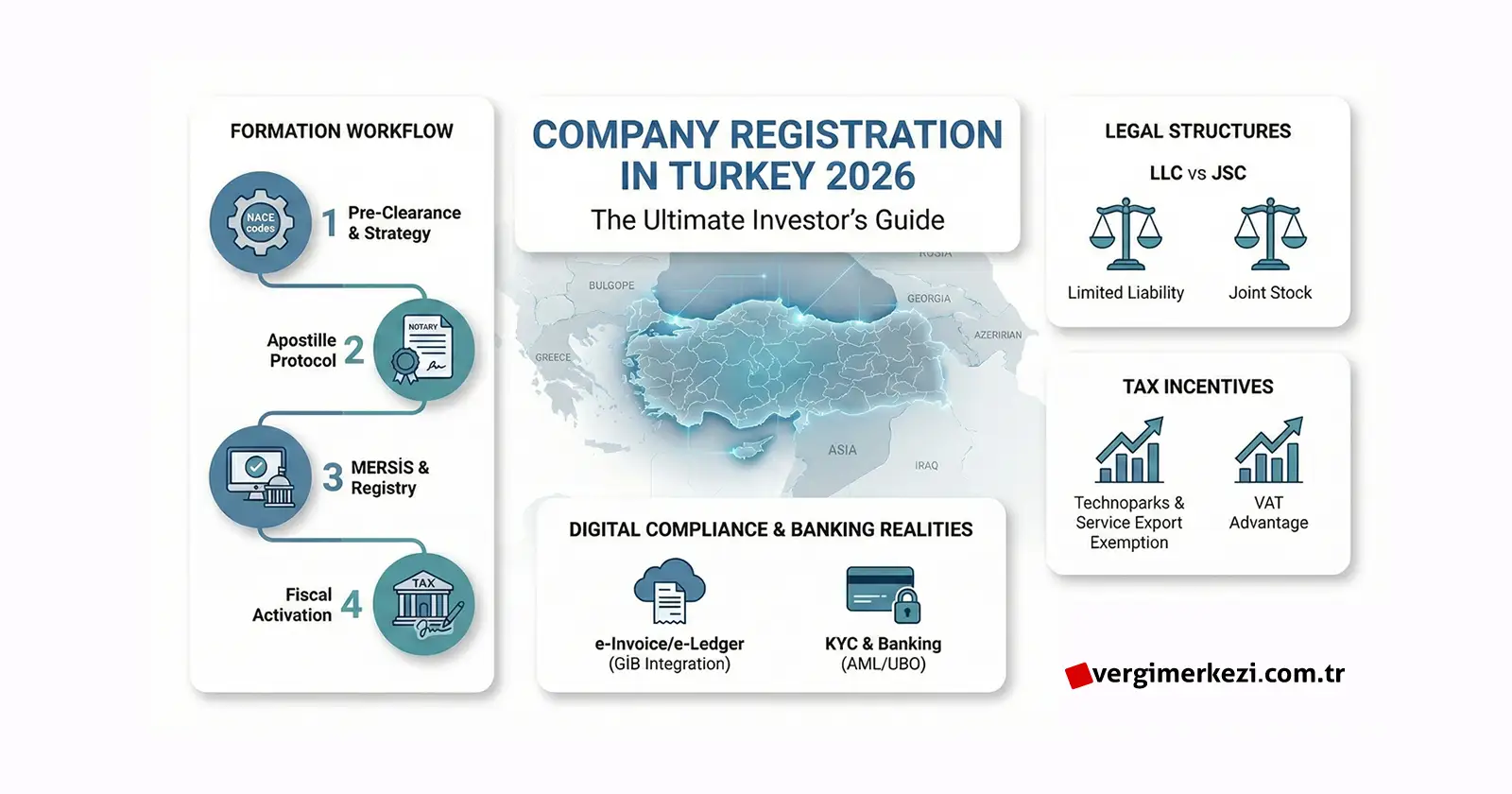
We utilize a “compliance-first” methodology to ensure your entity is active within 5–10 business days (excluding document logistics).
Phase 1: Preparation & Clearance
Structure Design: Defining the NACE codes (activity scope) is critical. Generic scopes can trigger banking rejections later.
The “Potential” Tax Number: Before incorporation, foreign shareholders must obtain a tax ID from the interactive tax office. This is the digital key to the entire process.
Phase 2: The Apostille Protocol
The Bottleneck: The #1 cause of delay is incorrect apostilles. Documents (Passports, Foreign Trade Registry Extracts) must be notarized and apostilled in the home country.
Translation: These must be sworn-translated and notarized in Turkey.
Phase 3: MERSİS & Trade Registry
Digital Filing: We generate the Articles of Association (AoA) via MERSİS (Central Registry System).
Competition Authority Fee: A small percentage (0.04%) of capital is paid to the Competition Authority.
Registration: The local Trade Registry approves the entity. The company is now legally “born.”
Phase 4: Fiscal Activation (The “Vergi Merkezi” Role)
Signature Circular: Notarized authorization of signatories.
Tax Office Activation: We link the entity to the tax administration system.
Physical Inspection: A tax officer will physically visit your registered address to verify existence. For virtual offices, this process is managed digitally or via appointment.
4. Banking Realities: The “Know Your Customer” Barrier
Contrary to simplistic guides, opening a corporate bank account is the most challenging step for foreign investors in 2026 due to strict AML (Anti-Money Laundering) regulations.
Physical Presence: While formation is remote, banking often requires a visit.
Source of Funds: Be prepared to show the “flow of funds” and ultimate beneficial ownership (UBO) charts.
Blocked Capital: For JSCs, 25% of capital must be blocked before registration. For LLCs, capital can be deposited within 24 months (though early deposit aids credibility).
5. The Digital Compliance Stack
Turkey utilizes one of the world’s most advanced digital tax systems. Compliance is non-negotiable.
e-Invoice & e-Archive: Paper invoices are obsolete. Your billing software must integrate with the Revenue Administration (GİB).
KEP (Registered Electronic Mail): An official email system used for legal notifications and serving notices.
e-Signature: The General Manager must have a valid e-signature token for government filings.
6. Taxation & Strategic Incentives
Beyond the standard Corporate Income Tax (CIT) rate (approx. 25%), Turkey offers targeted relief mechanisms.
Service Export Exemption: Companies providing services (software, design, engineering, data) to clients outside Turkey may exempt 50% to 80% of that income from corporate tax, provided proceeds are brought into Turkey.
Technoparks: Located in designated zones, offering full CIT exemptions and payroll tax relief for R&D personnel.
VAT Mechanism: The standard rate is 20%, but exports of goods and services are generally VAT-exempt (0% VAT), allowing for VAT refunds on local expenses.
7. Operational Cost & Maintenance
Running a company involves fixed statutory costs:
CPA (Mali Müşavir) Fees: Mandatory by law to submit tax returns.
Stamp Duties: Applicable to contracts, leases, and payrolls.
Withholding Tax (Stopaj): A tax on payments like rent and professional services, paid by the company on behalf of the recipient.
Your Next Step
Formation is just the beginning. Vergi Merkezi | Mali Müşavirlik specializes in guiding international investors through the complex intersection of Turkish Commercial Law and Tax Legislation.
Would you like us to review your draft business activity to recommend the optimal NACE codes and tax structure?
For Online Services and Information Contact Us
Ready to establish or grow your business in Turkey? Contact Vergi Merkezi | Mali Müşavirlik today for a consultation with our expert accountants.









Bir yanıt yazın