
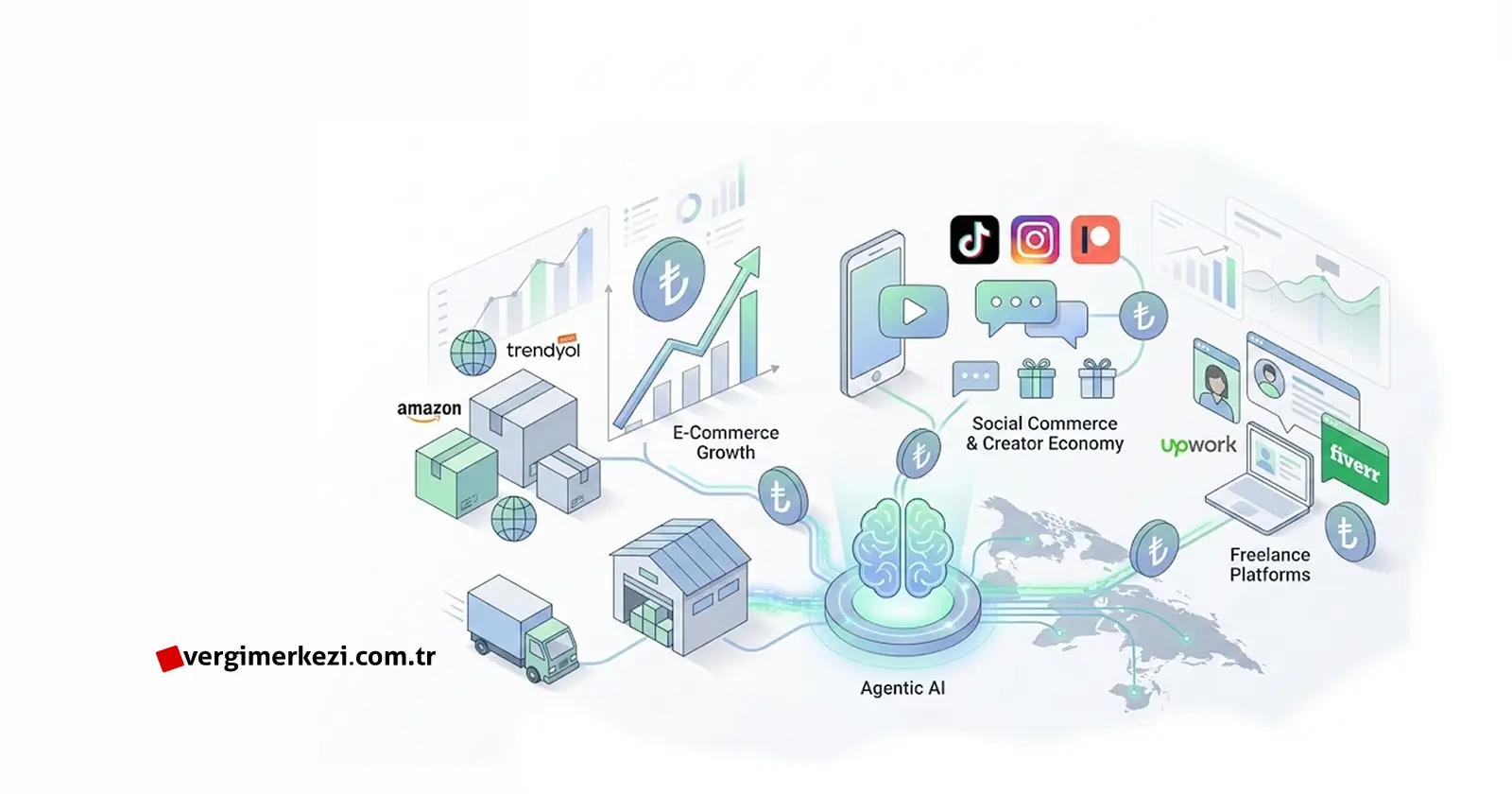

Turkey is rapidly evolving from a traditional manufacturing hub into a strategic command center for the global digital economy. With e-commerce volume growing by 61.7% in 2024 to exceed 3 trillion TL, the country offers a unique value proposition for foreign investors: a bridge between Europe and Asia, combined with aggressive tax incentives for digital exporters.This guide analyzes the “Agentic AI” era opportunities for foreigners planning to incorporate in Turkey.
Why Turkey? Digital Economy Incentives Table (2026)
| Incentive / Advantage | Benefit for Foreign Investors |
|---|---|
| Service Export Exemption | 80% Income Tax Exemption on earnings (Software, Design, Data) |
| Micro-Export (ETGB) | VAT Refund on export goods & Simplified Customs |
| Social Content Exemption | ~15% Withholding Tax (Capped at ~5.4M TL revenue) |
| Strategic Logistics | Access to MENA (Middle East) & EU markets via Trendyol/Amazon |
1. The “Service Export” Advantage: 80% Tax Exemption
For digital nomads, software developers, and agencies, Turkey offers one of the most competitive fiscal regimes in the OECD. If you establish a company in Turkey and provide services to clients outside of Turkey, you can deduct 80% of your earnings from the income tax base.
Eligibility Criteria
To qualify for this exemption, outlined in Turkish tax laws, three conditions must be met:
- Service Type: Must be in software, engineering, design, data analysis, or medical reporting.
- Foreign Client: The invoice must be issued to a customer abroad.
- Foreign Currency: The payment must be brought into Turkey in foreign currency (USD/EUR).
📌 Practical Insight: If you earn $100,000 annually via platforms like Upwork or direct contracts, tax is calculated on only $20,000 after the exemption, provided the funds enter a Turkish bank account.
2. E-Commerce & Logistics Hub: The “Digital Silk Road”
Turkey is not just a market; it is a logistics hub. With the global e-commerce volume expected to reach $83.26 trillion by 2030, positioning your inventory in Turkey allows you to serve both the European and the emerging MENA (Middle East & North Africa) markets.
Amazon FBA vs. FBM in Turkey
While 82% of sellers prefer Amazon FBA (Fulfillment by Amazon) for scalability, the rising storage fees predicted for 2026 make the FBM (Fulfillment by Merchant) model attractive for Turkey-based companies.
- Cost Efficiency: Warehousing and labor costs in Turkey are significantly lower than in the EU or US.
- Micro-Export (ETGB): You can ship goods up to 15,000 Euros and 300 kg via “Micro-Export” regulations without dealing with complex customs declarations.
- VAT Refund: Exporters can claim a refund on the VAT paid during the manufacturing or purchasing of goods, adding a 10-20% margin to your bottom line.
The “Gulf Expansion” Opportunity
Turkish platforms like Trendyol are aggressively expanding into the Gulf region (Saudi Arabia, UAE, Qatar), aiming for a $50 billion e-commerce volume by 2028. A Turkish entity gives you direct access to this “Digital Silk Road,” allowing you to sell globally while managing operations locally.
3. Social Commerce & Creator Economy Regulations
For influencers and content creators relocating to Turkey, the tax regime is simplified. The “Social Content Creator Exemption” allows individual creators to pay a flat ~15% withholding tax on revenues up to approximately 5.4 million TL (2025 estimate).
Important Distinction: Individual vs. Agency
This exemption applies strictly to individual bank accounts. If you set up a Limited Liability Company (LLC) or operate an agency (managing other creators, e.g., for OnlyFans or TikTok Live), you fall under standard commercial tax laws and cannot use this specific exemption. You must establish a full commercial entity.
4. Financial Compliance: Bringing Money In
Turkey imposes certain regulations on capital flow to support its reserves. For service exports, while bringing foreign currency into the country is mandatory to claim tax benefits, the strict requirement to convert these funds into Turkish Lira (IBKB) has been relaxed for amounts under 15,000 Euros.
Cryptocurrency Note: Using crypto for payments for goods and services is restricted within Turkey. However, receiving crypto from abroad and converting it to fiat via licensed Turkish exchanges is currently treated as asset trading, though stricter regulations are expected by 2026.
FAQ: Establishing a Business in Turkey
Can a foreigner set up a Sole Proprietorship in Turkey?
Yes, foreigners with a valid residence permit and a foreign ID number (YKN) can establish a sole proprietorship. However, for scalability and liability protection, a Limited Liability Company (Ltd. Şti.) is often recommended.
Does the 80% tax exemption apply to YouTube income?
No. The 80% exemption is for “Service Exports” (B2B services like coding, design). YouTube income falls under the “Social Content Creator” exemption (Article 20/B), which has a flat ~15% tax rate up to a certain limit.
Is it mandatory to have a physical office?
No. You can use a virtual office address for your company notification address. This is a legally accepted practice in Turkey and reduces initial overhead costs.
Professional Support
Navigating the Turkish tax code, especially the distinctions between “Service Export” deductions and “Social Content” exemptions, requires local expertise. A simple coding error or missing document can lead to the loss of significant tax advantages. Vergi Merkezi | Mali Müşavirlik offers specialized incorporation and tax planning services for foreign investors.
📍 Service Areas: Istanbul, Ankara, Izmir, Bursa, and Worldwide via Digital Consultation.
For Online Services and Information Contact Us
Ready to establish or grow your business in Turkey? Contact Vergi Merkezi | Mali Müşavirlik today for a consultation with our expert accountants.
- 📞 Phone: +90 533 328 37 04
- 📧 Email: [email protected]
⚠️ Legal Disclaimer: This content is based on the projections and regulations available as of the publication date.
📚 References
Primary Sources
- Turkish Ministry of Trade Data
- Income Tax Law (GVK) Repeated Art. 20/B
- Service Export Regulations
Market Reports
- Deloitte & McKinsey AI Projections
- Grand View Research – Freelance Market



Bir yanıt yazın